
In this post
- What double cleansing means
- Why cleansing matters
- What the first cleanse does
- What the second cleanse does
- Potential benefits and realistic expectations
- What the evidence does and does not show
- Who may find it useful
- Who may want to skip or adapt it
- How to double cleanse gently
- Choosing the first cleanser
- Choosing the second cleanser
- Common mistakes that make cleansing harsher
- Double cleansing and different skin concerns
- How often should you double cleanse?
- Myths and misconceptions
- A realistic evening routine
- Frequently asked questions
- A practical decision guide
- Safety, patch testing, and when to seek help
- Conclusion: use the least cleansing that works
- Sources and further reading
what double cleansing means
Double cleansing is an evening face-washing method that uses two different cleansing steps. The first is usually an oil-based cleanser, cleansing balm, or micellar product designed to loosen makeup, sunscreen, excess sebum, and other material that resists water. The second is a water-based cleanser, often a gentle gel, lotion, or cream cleanser, used to wash away what remains.
The idea is simple: first dissolve and lift, then rinse and cleanse. It can be useful, but it is not a rule that everyone must follow. A well-chosen single cleanser may be enough for many people, and a second wash can be unnecessary or irritating if it leaves skin tight, raw, or uncomfortable.
Interest in double cleansing comes largely from Korean and Japanese beauty routines, where oil cleansers have long been used to remove makeup and sunscreen. Social media has made the method sound like a universal secret to clear, glowing skin. That claim goes too far.
Double cleansing does not guarantee clear pores, prevent acne, reverse aging, or make every serum work better. It is best understood as one practical way of removing stubborn products at the end of the day. Whether it helps depends on what you wear, how your skin feels, what cleanser you choose, and whether your current wash already removes everything comfortably.
This guide explains what each step does, why some people find the method helpful, and where the evidence has limits. It also covers who might benefit, who may want to skip the first step, how to choose products, and how to avoid over-cleansing. The goal is not to build the longest routine.
It is to make cleansing effective and comfortable while leaving the skin barrier in good shape. If one gentle wash removes your makeup and sunscreen and your skin feels fine afterward, there is no need to add another product simply because a routine online says so.
An important distinction: double cleansing is two cleansing steps, not necessarily two foaming washes. The first step can be a balm, oil, or micellar water. The second can be a mild non-foaming cleanser.
Some people use the same gentle cleanser twice, but repeating a wash is not always helpful and may increase dryness. The two-step approach is most logical when the first product is good at dissolving water-resistant residue and the second is good at rinsing away the oil or loosened material without leaving a film. The products should work together, not make the skin feel stripped.
Why cleansing matters
During the day, skin collects a changing mix of sweat, oil, dead skin cells, environmental particles, makeup, and skincare products. Sunscreen and makeup are intentionally designed to remain on the skin for hours, and some formulas are water resistant. At night, removing the products you want to take off helps you start with a comfortable surface for your usual evening routine.
Cleansing can also remove physical debris and excess oil. It is a basic hygiene step, but it is not a contest to make the skin feel squeaky clean. A soft, comfortable finish is a better target than a sensation of tightness.
The skin barrier is the outermost protective layer of the skin. It helps reduce water loss and helps keep irritants out. Cleansing interacts with that barrier because surfactants and friction can remove some surface lipids along with dirt and product.
A cleanser that is too harsh, water that is too hot, repeated washing, or vigorous rubbing can leave the skin dry or irritated. In contrast, a mild cleanser used briefly with lukewarm water can clean without making the skin feel uncomfortable. The goal is to remove what needs removing while disturbing the skin as little as possible.
Not every residue is harmful. Skin naturally produces sebum, and a light amount of oil after washing is not proof of poor hygiene. Nor does a face need to feel completely bare before a moisturizer can be applied.
Some cleansers leave a soft feel because they are formulated to be less drying. That is different from an unwanted layer of makeup or sunscreen that has not been removed. Your own comfort, the products you used that day, and any specific clinical advice matter more than an arbitrary idea that skin must be perfectly oil-free.
Cleansing can support a consistent routine because it removes the day’s makeup or sunscreen and lets you apply other products to clean skin if you choose. But it does not need to become an elaborate ritual. A routine that you can follow without discomfort is more useful than a complex sequence that causes stinging or takes so long that you skip it.
People with eczema, rosacea, acne, or very sensitive skin may need to be especially thoughtful about cleanser choice and frequency. Skin conditions can alter what is tolerable, so general beauty advice should not replace personalized medical guidance.
What the first cleanse does
An oil cleanser or balm can dissolve oily materials because many makeup and sunscreen ingredients mix more readily with oil than with plain water. When massaged gently over dry skin, the cleanser can help loosen foundation, long-wear concealer, mascara, lipstick, and water-resistant sunscreen. Many formulas are emulsifying: after water is added, the oil turns milky and rinses away more easily.
The first step can reduce the amount of rubbing needed with a cloth or cotton pad. The point is to let the product do the dissolving rather than scrub the face.
An oil cleanser is not the same as applying cooking oil or any household oil to the face. Cleansers are formulated to spread, emulsify, and rinse; they may contain surfactants and other ingredients that help them wash away. Balms are solid or semi-solid products that melt with warmth and are meant to be massaged and emulsified.
Cleansing oils are liquid. There is no single texture that is best for everyone.
If you dislike the feel of oils, a balm or micellar water may be easier to use. If you wear little makeup, the first step may not be needed on many evenings.
Micellar water is another possible first step. It contains tiny cleansing structures suspended in water that can help lift makeup and oil. It is often applied with a cotton pad, though some products can be rinsed and some users prefer to rinse them even when the label says that is optional.
Repeated wiping can create friction, particularly around the eyes or on reactive skin. Use enough product to keep the pad slippery, press briefly over makeup, and wipe gently rather than dragging. If micellar water leaves a film or causes discomfort, rinse it or choose another removal method.
Eye makeup sometimes needs extra patience. Waterproof mascara and long-wear eyeliner may take longer to dissolve than everyday face makeup. Close the eye, hold a saturated pad or a small amount of eye-safe cleansing product over the area for several seconds, then wipe softly.
Avoid getting cleanser in the eye, and do not pull lashes or scrub the delicate skin. If a product burns, stop and rinse with clean water. People with contact lenses, dry eyes, or a history of eye irritation may prefer products specifically labeled for eye-area use and should follow the relevant instructions.
The first cleanser is not required to be a special expensive product. It needs to suit your skin, remove the products you wear, and rinse without leaving you uncomfortable. Fragrance-free choices may be easier for some sensitive users, although fragrance is not automatically a problem for every person.
Ingredient lists can help identify potential irritants, but a long list is not a reliable measure of quality. If you have known allergies, check the specific ingredients and ask a clinician or pharmacist when unsure. If a product causes persistent redness, swelling, rash, or burning, stop using it.
What the second cleanse does
The second cleanser is usually a water-based face wash. It removes the emulsified first cleanser and any loosened residue that remains. It can also wash away sweat, dirt, and everyday oils.
Some people prefer a gentle gel that foams lightly; others do better with a cream, lotion, or non-foaming cleanser. The texture does not determine whether a cleanser is gentle. What matters is how your skin responds and whether the product can clean without persistent tightness, burning, or flaking.
A second cleanser should not be treated as a chance to scrub more intensely. Use a small amount, spread with fingertips, and wash for a short period according to the product’s directions. There is no need to use a cleansing brush, rough cloth, exfoliating grains, or multiple active ingredients during the same wash unless a clinician has specifically directed you to do so.
Rinse thoroughly with lukewarm water and pat dry with a clean towel. If residue remains around the hairline or jaw, a careful rinse is often more useful than repeating the entire routine.
Some people find that a second wash makes their skin feel fresher, especially after a full face of long-wear makeup. Others find the same step leaves their skin dry. These are both real experiences, and they can reflect differences in formulas, amount used, technique, climate, and skin sensitivity.
If the second wash is uncomfortable, consider a gentler cleanser, a shorter wash, or one thorough cleanse instead. If using two products already leaves you itchy or flaky, persistence is not a virtue. Adjust the routine.
A second cleanser is not automatically necessary because the first product feels oily. Proper emulsification and rinsing matter. Add water to an emulsifying oil or balm and massage until it turns milky, then rinse well.
If the product does not emulsify, leaves a persistent film, or is difficult to rinse, it may not be a good fit. Sometimes using less product or more water solves the issue; sometimes a different formula is simpler. If your second cleanser is very strong, it can counteract the comfort you hoped to get from the first step.
Potential benefits and realistic expectations
The most straightforward possible benefit is more reliable removal of heavy or water-resistant products for people who struggle to remove them with one wash. This is a practical benefit, not a promise of a medical outcome.
If you wear long-wear foundation, layered sunscreen, or water-resistant eye makeup and your current cleanser leaves visible residue, a dissolving first step may make removal easier and reduce rubbing. If your single cleanser already removes everything comfortably, a second cleanser may not add meaningful value.
Double cleansing may reduce the temptation to use vigorous wiping. A product that loosens makeup can allow it to lift away with gentle massage or a soft rinse. That can be helpful because friction can irritate delicate or already inflamed skin.
The advantage depends on technique. A person can still over-massage, press too hard, use a rough washcloth, or repeatedly wipe with cotton pads. A two-step routine is not automatically gentler; it is gentler only when the products and method actually reduce force.
Some people enjoy the sensory experience. A balm can feel soothing to massage, and a consistent evening ritual can help them remember to remove makeup and sunscreen. Enjoyment and adherence are reasonable considerations when choosing a routine.
However, an enjoyable ritual should not be presented as a proven health effect. There is no established rule that the skin must be massaged for a specific duration or that oil cleansing alone produces a detoxifying effect. Skin is not being detoxed by the cleanser; the product is helping remove materials from its surface.
People sometimes report fewer clogged-feeling areas after changing how they remove makeup. That experience may be real for them, but it cannot be assumed that double cleansing treats acne or prevents breakouts in everyone. Acne has multiple contributing factors, and cleansers are only one piece of care.
The available studies on cleanser routines are limited. If acne is persistent, painful, or causing scars, a dermatologist can discuss evidence-based treatment options. Adding harsher cleansing or repeated washing may irritate acne-prone skin and can make a routine harder to tolerate.
Removing sunscreen at night is often cited as a reason for double cleansing. Sunscreen should be applied as directed during the day, and removing it at the end of the day is sensible. Yet the type of sunscreen and cleanser matter.
Some sunscreens rinse off with a mild cleanser; others may need an oil-based remover or a dedicated makeup remover. One small study of selected sunscreens found different residue after water, cleanser, and cleansing oil, but it did not establish that all sunscreen requires two cleanses. Product testing and skin types vary, so individual experience remains important.
A clean surface may make evening skincare feel more comfortable, especially if makeup or sunscreen has been removed. There is no need to claim that double cleansing increases the absorption of every serum, makes treatments work faster, or opens pores. Pores do not open and close like doors.
If a skincare product has directions for use on clean skin, gentle cleansing is enough to follow those directions. More washing is not a shortcut to stronger results and may increase irritation if it compromises the barrier.
What the evidence does and does not show
Beauty advice often presents double cleansing as a scientifically settled requirement. Research does not support such a sweeping claim. Studies examine particular products, formulas, skin types, and removal methods.
A result about one tested sunscreen and one tested cleanser cannot automatically be applied to every product sold today. Much of the everyday advice comes from practical experience and cosmetic formulation principles rather than large clinical trials comparing long-term skin outcomes from one versus two cleansing steps.
A small 2020 study by Chen and colleagues examined removal of selected sunscreens using water, a cleanser, and a cleansing oil. It included 20 participants and measured residue after the tested procedures. In that specific study, residue from the tested water-resistant sunscreen was lower after cleansing oil than after water or the tested cleanser.
The results are interesting, but the sample was small and the findings relate to those specific products and conditions. They do not prove that everyone needs a two-step routine, that oil cleansing prevents acne, or that all sunscreen behaves the same way.
The study’s practical message is narrower: some water-resistant sunscreen may be difficult to remove with water alone, and a suitable cleansing oil can help remove certain formulations. People should not interpret a research percentage as a universal probability that sunscreen remains on their own skin. Formulations change, application amounts differ, and methods of assessment matter.
The study also does not establish the long-term health effect of small amounts of residue. It is a useful piece of evidence, not a universal cleansing law.
Evidence about facial cleansers and acne also has limitations. A systematic review of prospective studies found that the evidence base was limited and that reliable recommendations were difficult to draw. Cleansers vary widely, and skincare routines often include multiple products at once.
That makes it hard to attribute a change in acne to a particular cleansing sequence. If a person changes cleanser, moisturizer, sunscreen, and treatment simultaneously, they cannot easily know which change helped or caused irritation.
Professional guidance from the American Academy of Dermatology emphasizes gentle face washing: use a non-abrasive cleanser, lukewarm water, fingertips, avoid scrubbing, rinse, pat dry, and generally wash twice daily and after sweating. This advice supports the importance of gentle technique and avoiding excess washing.
It does not require everyone to double cleanse. A first removal step can fit within a gentle routine when needed, but the overall principle remains to cleanse without irritating the skin.
The strongest conclusion is therefore modest. Double cleansing can be a helpful removal method for some products and routines. Whether it is worthwhile depends on your makeup, sunscreen, skin comfort, and cleanser performance.
It has not been shown to be mandatory for all skin types, nor should it be promoted as a treatment for acne or a way to detox the skin. When writing or talking about skincare, keeping the strength of the claim in line with the evidence protects readers from buying unnecessary products or overcomplicating routines.
Who may find it useful
You may consider trying a first cleanse if you wear full-coverage or long-wear makeup most days. Foundation, waterproof mascara, transfer-resistant lipstick, and setting products can be designed to stay in place.
A cleansing oil or balm may loosen these products before you use a gentle face wash. You may also find the method useful if one cleanser leaves visible makeup on a towel or around the hairline, or if you are rubbing repeatedly to remove your usual products.
People who use water-resistant sunscreen may find a dedicated remover useful, particularly if a single gentle wash does not seem to remove the formula comfortably. This is not a recommendation to scrub until the skin feels bare. Instead, choose a remover that is compatible with the sunscreen and your skin, follow its directions, and observe whether your face feels clean without tightness.
Some sunscreens are easier to remove than others. Read the product’s directions and pay attention to your own experience.
Anyone who enjoys using an oil cleanser and can rinse it comfortably may include it as an optional step. Routines are personal, and a practical product that you like can make it easier to remove makeup at night. The most useful routine is one you can maintain without feeling pressured to purchase several items.
If the first step does not solve a real problem, or you dislike the texture, you can skip it. You do not need to prove that your skin is clean by using two products.
People with sensitive or reactive skin might sometimes benefit from an oil-based remover because it can reduce rubbing, but they may also be more likely to react to fragrance or other ingredients. Patch testing a new product on a small area, introducing one new product at a time, and avoiding contact with irritated skin can help identify problems.
Patch testing does not guarantee that a product will never cause a reaction. If you have a known skin condition or frequent reactions, ask a dermatologist for product guidance.
People who wear sunscreen, makeup, or both only occasionally can decide based on those days rather than treating double cleansing as an everyday obligation. Perhaps you use one cleansing oil after a day with makeup but use a single gentle cleanser on a day when you wore only a light, easy-to-remove product.
A flexible routine can be sensible. There is no need to keep the same number of steps every night if the products you wore changed.
Who may want to skip or adapt it
If your skin is already dry, flaky, tight, or easily irritated, begin with the simplest effective cleanse. Adding a second cleanser can increase exposure to surfactants, water, and rubbing. A two-step method may still work if the first product is very gentle and prevents scrubbing, but it is not automatically the safer option.
Monitor how your skin feels after washing and the next morning. Persistent discomfort is a signal to simplify or seek professional advice.
People with eczema, rosacea, or a compromised skin barrier may need to limit fragrance, exfoliating cleansers, and frequent product changes. The trigger profile is individual, so there is no one list that is safe for everyone. During a flare, even previously tolerated products may sting.
Follow advice from your clinician and avoid experimenting with a complex routine on inflamed skin. If you have open, cracked, or weeping skin, get personalized medical guidance about cleansing rather than relying on an online routine.
If a single cleanser removes your sunscreen and makeup without visible residue or discomfort, there is no evidence-based reason that you must add another cleanser. You can test your method gently, but you do not need a second product simply because an influencer uses one.
A cleanser’s marketing phrase like ‘deep clean’ does not prove it is needed. Comfort and effective product removal are better measures than the number of steps.
If you are tempted to double cleanse because of acne, remember that acne is not caused by a simple failure to wash twice. Washing more often or using harsh products can irritate the skin. A gentle cleanser can be part of acne care, but treatment often involves ingredients that target acne processes and may need guidance.
If breakouts persist, are painful, or leave scars, consider seeing a dermatologist. Do not use repeated cleansing as a replacement for care that addresses the cause of acne.
Those who have very dry or mature skin may prefer a single creamy cleanser and a moisturizer rather than two washes. Skin can become drier with age, environmental conditions, certain medications, or treatments. A cleansing balm followed by a mild lotion cleanser may be comfortable for some people, but it can be too much for others.
The fact that a texture feels luxurious does not determine whether the routine is suitable. Pay attention to the skin’s response, not the demographic label alone.
People with eye conditions or a history of eyelid dermatitis should be particularly cautious around the eyes. Avoid fragranced or irritating products near the eyelids unless directed otherwise. Remove eye makeup with a product made for that purpose, and do not scrub lashes.
If redness, swelling, itching, or persistent tearing develops, stop the suspected product and consult a healthcare professional. Eye-area symptoms deserve care; simply switching to a stronger cleanser may worsen the problem.
How to double cleanse gently
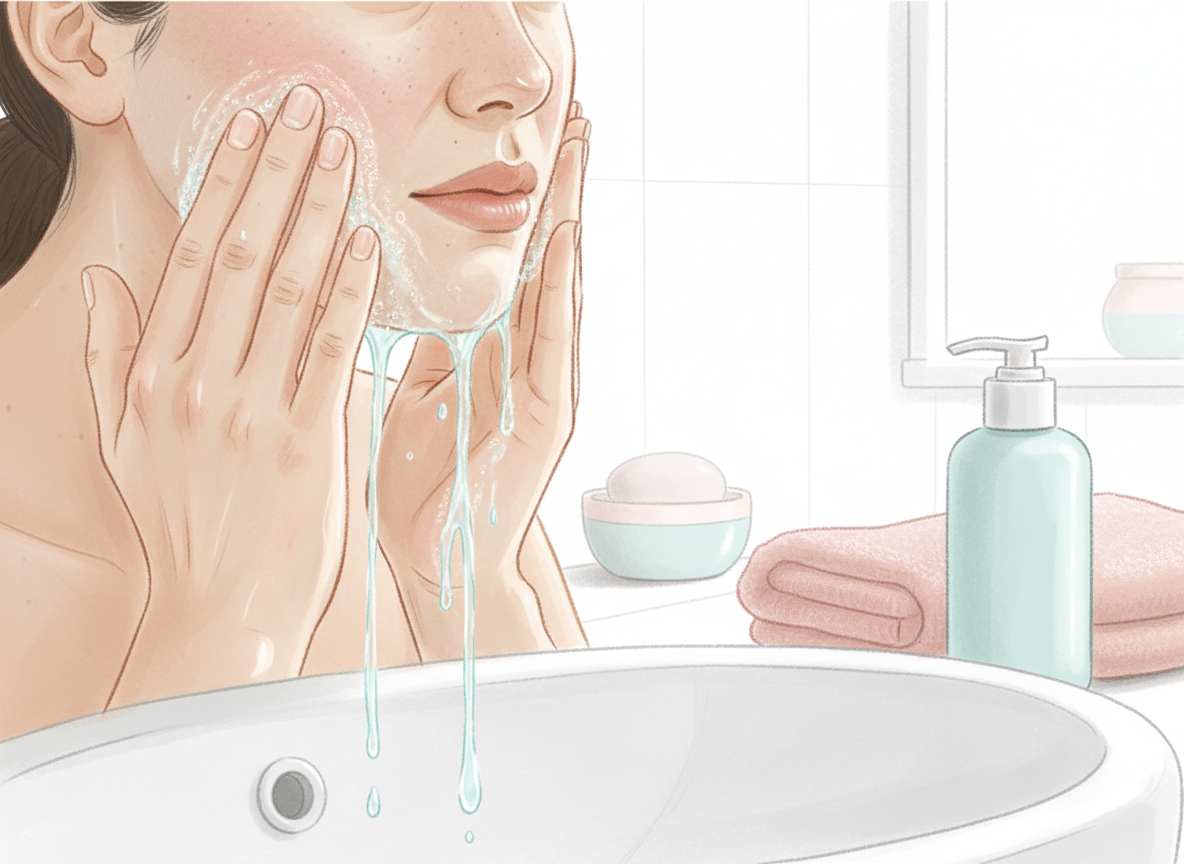
Start with dry hands and a dry face if your oil cleanser or balm directions call for that. Use the amount specified on the package; often a small amount is enough. Warm the product between your fingertips, then spread it over the face with light pressure.
If you are wearing eye makeup, follow the product’s eye-area directions and avoid getting it in the eye. Keep your movements slow and gentle. You are dissolving product, not massaging deeply into muscles or trying to force pores to empty.
Massage for only as long as needed to loosen makeup and sunscreen. A brief, gentle application is usually more practical than an extended massage. There is no universal requirement to massage for a fixed number of minutes.
If makeup remains, add a little product or spend a few extra seconds on the area rather than pressing harder. Avoid prolonged rubbing, especially over active breakouts, irritated patches, and the delicate eye area.
Add lukewarm water gradually if the product emulsifies. The oil may turn cloudy or milky as it mixes with water. Continue a light massage so the cleanser can disperse, then rinse thoroughly.
If the label gives a specific method, follow it. Do not use hot water to speed up removal; heat can worsen dryness or redness for some people. The face should not need intense heat or steam for a cleanser to work.
Use the second cleanser only if it is useful for your routine. Wet the face, apply a small amount, and gently glide it across the skin. Avoid scrubbing with fingernails, rough cloths, cleansing brushes, or exfoliating pads.
Rinse until the product is gone, paying attention to the hairline, sides of the nose, and jaw. Pat with a clean towel rather than rubbing vigorously. If the first step already leaves the skin comfortable and clean, your product directions and personal experience can help you decide whether a second wash is necessary.
Apply moisturizer after cleansing if it is part of your routine, particularly if your skin tends to feel dry. Use treatment products according to their directions and introduce them thoughtfully. Double cleansing is not a reason to use more active ingredients or to apply a treatment to irritated skin.
If a retinoid or other product causes excessive irritation, discuss frequency and technique with a clinician. Cleansing can prepare your routine but does not override the need to use treatments safely.
Keep clean hands and washcloths. Reusing a damp, dirty cloth can irritate skin or transfer residue. You do not need a special microfiber towel for a good cleanse; a soft, clean towel is fine.
Avoid sharing face cloths if possible. Rinse reusable tools thoroughly and allow them to dry.
If you use a cotton pad, do not use it repeatedly after it becomes soiled. A fresh pad and gentle pressure reduce unnecessary dragging.
Looking for products to build your routine?
Choosing the first cleanser
Choose a first cleanser based on the products you need to remove and the way your skin tolerates ingredients. Cleansing oils and balms are often designed to break down makeup and sunscreen, then rinse away. Micellar water can be convenient for light makeup or travel, though wiping technique matters.
Some people use a dedicated eye makeup remover for waterproof products. The most expensive choice is not necessarily the most effective for you. Start with a simple product that works for your actual routine.
Look at how the product is meant to be used. Some cleansing oils are designed for dry skin, then emulsified with water; others have different instructions. Some balms ask you to apply and rinse directly.
Follow the label instead of assuming every formula works the same way. If an oil product is used incorrectly, it may leave a film or feel difficult to remove. If correct use still leaves you uncomfortable, you may prefer a different type.
Fragrance is a matter of individual tolerance. Some users enjoy fragrance without any issue; others notice stinging or a rash. If you have reactive skin, fragrance-free products may be a reasonable place to start. ‘Natural’ fragrance or essential oils can still irritate certain people.
Conversely, a product being fragrance-free does not guarantee that no one will react to it. Check known allergens, and stop if you develop a reaction.
Consider the eye area separately. A product suitable for cheeks is not automatically comfortable around eyelids. If a cleansing oil clouds your vision or stings, switch to an eye makeup remover labeled for your needs.
Never force a product through discomfort. If makeup is difficult to remove, letting a suitable remover sit briefly is often gentler than scrubbing. Follow any contact-lens instructions provided by the product manufacturer.
Do not choose a cleansing oil based on the idea that an oil must be comedogenic or non-comedogenic for everyone. Labels and ingredient lists do not predict every individual’s response.
Rinse-off products have a different exposure pattern from leave-on oils, and formulas contain multiple ingredients. If a new product seems to trigger irritation or breakouts, pause it and see whether symptoms settle; consider changing one item at a time so you can understand what may be contributing.
Choosing the second cleanser
A second cleanser should be mild enough for regular use and effective enough to remove the first product and everyday residue. You might prefer a low-foaming gel, a cream cleanser, or a fragrance-free lotion cleanser. There is no universally correct pH or texture for every person.
If you are unsure, a basic gentle cleanser without scrub particles or strong fragrance is a reasonable starting point. Follow the label and avoid using a medicated cleanser more often than directed.
Foam is not proof of cleaning power. A foaming cleanser may be comfortable and effective, while another may feel drying; a non-foaming wash may suit some people better, but it can also leave residue if not rinsed thoroughly.
Judge by how it cleans and how your skin feels after. If your face feels squeaky, tight, or stings when you apply moisturizer, consider whether the cleanser or washing frequency is too harsh.
Some cleansers contain exfoliating or acne-directed ingredients such as salicylic acid or benzoyl peroxide. These may be useful for specific concerns, but they are not required for everyone and can cause irritation, especially when combined with leave-on treatments.
If you already use a prescribed treatment or strong active products, ask a dermatologist or pharmacist whether a medicated wash fits your routine. The second cleanse should not become an excuse to stack multiple exfoliants.
Pay attention to your water and environment. Hard water, cold weather, indoor heating, frequent swimming, or occupational exposure can affect how skin feels. A cleanser that works in summer may feel drying in winter.
Adjusting frequency or formula seasonally can be reasonable. If your skin is unusually irritated, simplify first rather than adding several new products to compensate.
Common mistakes that make cleansing harsher
One common mistake is washing for too long. A lengthy massage can feel relaxing, but cleanser is not a leave-on treatment. More contact time does not necessarily improve removal, and friction can add irritation.
Spend enough time to loosen makeup, emulsify, and rinse; follow product directions. If you need to rub for a long time, the product may not be a good match or you may need a different removal method.
Another mistake is using very hot water. Hot water can feel soothing in the moment but may leave some people drier or redder. Lukewarm water is a practical middle ground.
It does not need to be carefully measured. If the water feels hot on your hands, it is likely hotter than necessary for facial cleansing. Gentle temperature and gentle pressure work together.
Using a rough cloth, cleansing brush, or exfoliating scrub can turn a basic wash into mechanical exfoliation. These tools may be irritating if used too often or on sensitive skin. They are not required to remove makeup.
Fingertips are sufficient for most face washing, as dermatology guidance advises. If you choose to use a tool, follow its instructions, keep it clean, and stop if it causes redness or discomfort.
Repeating the same strong foaming cleanser twice is not automatically double cleansing in the useful sense. If the first wash already removes makeup, a second wash may only increase surfactant exposure.
A first-step dissolver followed by a gentle rinse-off cleanser is a more common approach, but even that is optional. The label ‘double cleanse’ does not make the routine gentler or more effective unless each step serves a purpose.
Rubbing cotton pads over the face until they look perfectly white can encourage unnecessary friction. The color on a pad is not a clinical measure of skin cleanliness. Makeup, sunscreen, and natural oils can transfer differently.
If your face feels clean and comfortable and no obvious product remains, you do not need to keep wiping. Use enough remover to reduce dragging and follow with a rinse when appropriate.
Buying more steps after watching a routine video is another avoidable pitfall. More products mean more chances for irritation, expense, and confusion about what is helping. If you want to try double cleansing, test the simplest version and observe your skin for a couple of weeks.
Avoid changing your cleanser, moisturizer, serum, and treatment all at once. An uncomplicated routine can be effective and easier to troubleshoot.
Double cleansing and different skin concerns
For dry skin, focus on comfort. A balm or oil cleanser may be useful on makeup days, but the second cleanser should be gentle and brief. Some people with dry skin prefer one creamy wash and find that enough.
Moisturize after cleansing, and consider reducing morning washing if it contributes to dryness. Individual needs vary, and a dermatologist can help if dryness is persistent, painful, or associated with a skin condition.
For oily skin, the urge to remove every trace of oil can be strong. However, aggressive cleansing can irritate the skin and may leave it feeling uncomfortable. Oiliness does not mean you must use two cleansers.
If sunscreen or makeup is difficult to remove, try a first-step remover and a balanced gentle wash. Avoid responding to midday shine with repeated face washing; blotting or adjusting products may be more comfortable.
For acne-prone skin, cleansing should be gentle and consistent. Double cleansing may help remove long-wear makeup for someone who uses it, but it is not an acne treatment by itself. Avoid scrubbing active blemishes or using multiple strong cleansers.
If using benzoyl peroxide, salicylic acid, adapalene, or prescription treatment, follow the directions and be aware of dryness or irritation. A healthcare professional can help build a treatment plan if over-the-counter care is not enough.
For sensitive skin, fewer steps can make it easier to identify triggers. If you wear substantial sunscreen or makeup, a carefully chosen first remover might reduce rubbing, but introduce it slowly. Prefer products you already know you tolerate where possible.
Do not start several new products at once. Stop a new product if it causes significant burning, swelling, hives, or worsening rash, and seek medical help for severe reactions.
For combination skin, different areas can respond differently. The cheeks may be dry while the forehead and nose feel oilier. A gentle full-face wash is often simpler than applying multiple cleansers to separate zones.
If a first cleanse is needed for makeup or sunscreen, apply it softly to the whole face and rinse; avoid repeatedly targeting oily areas. Moisturizer can be adjusted by area if needed.
For skin with rosacea, eczema, or another diagnosed condition, treatment plans vary. General skincare advice cannot account for every trigger or medication. Use guidance from your clinician and keep the cleansing routine as comfortable as possible.
If a product recommended online conflicts with your medical plan or causes a flare, follow professional advice. A two-step cleanse should never be treated as mandatory for someone managing a skin condition.
How often should you double cleanse?
Many people who use the method do it in the evening, when they remove makeup, sunscreen, and the day’s products. There is usually no reason to double cleanse both morning and night unless a clinician has advised otherwise. In the morning, some people rinse with water or use one gentle cleanser depending on skin type and preference.
The goal is not to meet a quota of cleansing steps. The goal is a comfortable routine that fits the products you used.
You can vary the routine by day. Use a first step after water-resistant sunscreen or makeup, and use one cleanser on days when you wore little or nothing difficult to remove. That is a reasonable way to reduce unnecessary washing.
If you are unsure whether one wash is enough, try it and assess whether makeup remains or whether the skin feels comfortable. Do not rely on an aggressive ‘squeak test.’
If you exercise and sweat, washing after heavy sweating can be helpful. The American Academy of Dermatology advises washing after sweating and generally washing the face twice daily. That does not mean every workout requires two separate cleansers.
A single gentle cleanse may be enough unless you also wore makeup or a difficult-to-remove sunscreen. Rinse sweat and use clean clothing or towels, while avoiding repeated harsh washing.
If your skin becomes dry or irritated after adding double cleansing, reduce the frequency or return to one cleanser. Improvement after simplifying can suggest that the added routine was not a good fit, though it does not diagnose the cause.
If irritation continues after stopping the suspected products, seek professional advice. Persistent symptoms deserve more than repeated product experimentation.
Myths and misconceptions
Myth: Everyone needs to double cleanse. Reality: It is an optional removal method.
Some people wear products that are easier to remove in two steps; many people do well with one gentle cleanser. Personal routine and product formulation matter.
Myth: Double cleansing prevents acne. Reality: Removing makeup can be useful, but acne has many causes and cleanser choice alone does not guarantee prevention or treatment. Stronger or more frequent washing may irritate acne-prone skin.
Myth: A face must feel squeaky clean. Reality: Tightness can be a sign that cleansing is too harsh or frequent.
Skin can feel comfortable and still be clean. A soft finish is not proof that the cleanser failed.
Myth: Oil cleansers clog everyone’s pores. Reality: Products and individual responses vary.
A rinse-off cleansing oil is formulated differently from a leave-on facial oil. If a specific product seems to cause trouble, discontinue it and choose another approach.
Myth: More time massaging means more benefit. Reality: Enough gentle contact to dissolve makeup is useful; prolonged rubbing can increase friction. No universal massage timer is required.
Myth: Double cleansing detoxes the skin. Reality: Cleansers remove some surface materials.
They do not detox the body or draw toxins out of pores. The liver and kidneys perform the body’s waste processing; skincare marketing should not imply otherwise.
Myth: It makes every serum absorb better. Reality: Cleansing removes surface product and prepares the skin for whatever comes next, but there is no basis for claiming that a second wash improves every skincare ingredient’s absorption or results.
Myth: One cleanser can never remove sunscreen. Reality: Some products rinse away with a single cleanser; some water-resistant formulas may need a dedicated remover. Check your own product and experience instead of applying a universal rule.
A realistic evening routine
A simple evening routine might begin with removing eye makeup if you use a separate eye-safe product. Next, use a cleansing oil or balm on days when you wore long-wear makeup or water-resistant sunscreen. Emulsify and rinse according to the label.
Then use one gentle cleanser if needed to remove the first product and remaining residue. Pat dry, apply treatments as directed, and moisturize. This is an example, not a required sequence for every person.
On a light-product day, you might use only one gentle cleanser. If your cleanser removes your sunscreen and any makeup comfortably, you can continue that routine. On a day when you wore only a tinted moisturizer or light makeup, you may find one cleanse is enough.
If you wore waterproof mascara and full coverage products, a first remover may be more useful. Adjust to the day rather than following a rigid checklist.
Do not confuse cleanser with exfoliant or treatment. A wash that contains exfoliating acids or acne medication can have a role, but using it twice may not be appropriate. Many leave-on treatments should be introduced gradually.
If you already use a prescription product, follow the prescriber’s directions. A balanced routine can be as short as cleanser, moisturizer, and sunscreen in the morning, and cleanser, treatment if appropriate, and moisturizer in the evening.
Keep products organized and notice patterns. If your skin feels tight only after double cleansing, try one wash or a gentler second cleanser. If your makeup remains after a single wash, consider a first step that dissolves it.
If a product stings every time, stop using it. Changing one variable at a time helps you learn what your skin tolerates, and writing a short note about new products can be helpful if you are troubleshooting.
Frequently asked questions
Is double cleansing necessary every night? No.
It can be useful when you wear makeup, water-resistant sunscreen, or products that are hard to remove. If you wore little and one gentle cleanser removes your products comfortably, a second step may be unnecessary.
Does double cleansing cause dry skin? It can if the products are harsh, the washing is too frequent, or there is too much friction.
It does not have to cause dryness. Choose gentle formulas, use lukewarm water, keep the wash brief, and stop or simplify if your skin becomes tight or irritated.
Can I double cleanse with the same cleanser twice? You can, but it may not offer a special advantage. If the cleanser is mild and the first wash loosens makeup, repeating it briefly may work for some people.
However, a strong cleanser used twice may be drying. A dedicated remover followed by a gentle cleanser is one option, not a requirement.
Should I use cleansing oil before or after a foaming cleanser? If you use an oil cleanser as the first step, it generally comes before the water-based cleanser.
Apply according to its directions, emulsify and rinse, then use the second cleanser if needed. Product labels take precedence because formulas differ.
Can I use micellar water as my first cleanse? Yes, if it removes the products you wear and your skin tolerates it.
Use enough to avoid dragging the pad, and rinse if the label recommends it or if it leaves a film or causes irritation. Some people prefer an oil or balm for waterproof products.
Will double cleansing remove blackheads? Cleansers can remove surface oil and makeup, but they do not reliably remove all blackheads or permanently shrink pores.
Avoid squeezing or scrubbing. If blackheads are a concern, a dermatologist can recommend evidence-based ingredients and methods suited to your skin.
Can I skip the second cleanser after an oil cleanser? Sometimes. It depends on the formula and whether it rinses cleanly.
Some oil cleansers are designed to emulsify and rinse away; others may leave a feel you dislike. Follow the product directions and judge by comfort and residue, not a fixed rule that everyone needs exactly two products.
Is double cleansing safe for sensitive skin? It can be, but sensitivity makes product choice and technique especially important.
Choose gentle, tolerated formulas, avoid fragrance if it is a known trigger, introduce one product at a time, and avoid rubbing. If you have a diagnosed skin condition, follow your clinician’s guidance.
Should I double cleanse in the morning? Usually it is not necessary. Many people use water or one gentle cleanser in the morning.
Double cleansing is most often considered at night to remove makeup and sunscreen. Your routine can vary with sweat, product use, and clinical advice.
Does double cleansing remove sunscreen completely? No method can guarantee perfect removal of every sunscreen under every condition.
A cleanser that works for your sunscreen is important; a first-step remover can help with some water-resistant formulas. Follow product directions and avoid harsh scrubbing.
Can I use a cleansing balm if I have oily skin? Oily skin does not automatically rule out a balm.
The formula should emulsify and rinse well, and the individual must tolerate it. If it leaves discomfort or seems to contribute to problems, discontinue it and use another remover.
How do I know whether I am over-cleansing? Warning signs can include persistent tightness, burning, flaking, redness, or worsening sensitivity after washing.
These symptoms have many possible causes, but reducing products and seeking medical advice when symptoms persist is sensible. Healthy cleansing should not leave your face painful.
A practical decision guide
Ask what you are trying to remove. If you wore long-wear makeup or a water-resistant sunscreen and your current cleanser requires repeated rubbing, a first-step remover may solve a practical problem.
If you wore nothing difficult to remove, one gentle cleanser might be all you need. This question keeps the routine tied to your actual day rather than to a trend.
Ask how your current cleanser performs. Does it remove the products you use? Does it rinse easily?
Does your skin feel comfortable afterward? If the answers are yes, you may not need to change anything.
If visible makeup remains or you feel compelled to scrub, you might try a balm, cleansing oil, or suitable micellar water. Avoid changing several products at once so you can evaluate the new step fairly.
Ask how your skin responds over time. One night of testing may show whether a product stings, but dryness or clogged-feeling areas may take longer to interpret. Introduce the first cleanser without also changing your moisturizer, treatment, and sunscreen.
If your skin becomes consistently uncomfortable, stop the new step. No routine is worth continuing just because it is popular.
Ask whether the routine is practical. If two steps make you skip cleansing altogether, simplify. If a first step makes removing makeup easier and helps you avoid rubbing, it may be worth keeping.
Your schedule, budget, sensory preferences, and product availability are part of a sustainable routine. The best routine is not the one with the most steps but one that meets your needs comfortably.
Safety, patch testing, and when to seek help
Whenever you introduce a new skincare product, consider testing a small amount on a limited area first and observing for a reaction. Follow the product label, and remember that a home patch test is not a guarantee against irritation or allergy.
Do not test on broken skin or near the eyes unless the product is meant for that area. If you have a history of allergic reactions, consult a professional about suitable products.
Stop a product if it causes strong burning, swelling, blistering, or a rapidly spreading rash. Rinse the area gently with water if appropriate.
Severe symptoms, eye involvement, breathing difficulty, or facial swelling need urgent medical attention. For persistent itching, redness, or flaking, contact a healthcare professional rather than layering on more products to mask the reaction.
Seek dermatology advice if you have ongoing acne, recurrent dermatitis, rosacea symptoms, or a barrier problem that does not improve when you simplify. A clinician can consider the cause, medication interactions, and specific treatment options.
Online routines cannot examine your skin or account for your medical history. General advice about gentle cleansing should be adapted to your personal plan.
If a product claims to treat a disease or make a medical promise, check what evidence supports it and consult a qualified professional. Cosmetic products can help with cleansing and appearance, but they should not be represented as curing conditions without appropriate evidence and regulatory basis. This article is educational and does not substitute for diagnosis or individualized medical care.
Conclusion: use the least cleansing that works
Double cleansing can be a useful option when makeup, water-resistant sunscreen, or other long-wear products are difficult to remove with one wash. An oil cleanser, balm, or micellar product may loosen those materials, and a gentle second cleanser can rinse away residue when needed.
The method can reduce the amount of rubbing for some people and make an evening routine feel more comfortable. Those are practical reasons to consider it.
It is not a universal requirement, acne cure, detox, or guarantee of glowing skin. Research is limited and product-specific, and professional face-washing guidance emphasizes gentle technique. If one cleanser removes your products comfortably, continue with it.
If you decide to add a first cleanse, choose a formula you tolerate, follow its directions, and stop if your skin becomes irritated. More steps are not automatically better.
Skincare works best when it respects the skin’s comfort and the person’s actual needs. Remove the products you want off, avoid unnecessary friction, moisturize when appropriate, and use sunscreen as directed.
Keep the routine manageable and seek professional guidance for persistent skin concerns. Double cleansing is a tool you can use when it helps; you are free to skip it when it does not.
Sources and further reading
American Academy of Dermatology Association. Face washing 101: patient guidance on gentle washing technique, including a non-abrasive cleanser, lukewarm water, fingertips, avoiding scrubbing, rinsing, patting dry, and general washing frequency.
Chen et al. Study on sunscreen removal methods, Journal of Cosmetic Dermatology (2020), doi:10.1111/jocd.12995.
This small study compared removal methods for selected sunscreen products. Its findings should be interpreted in light of its sample, specific products, and study methods; it does not establish that all sunscreen requires double cleansing.
Stringer et al. Systematic review of cleansers and acne, PubMed record.
The review describes limitations in the prospective evidence available for cleanser recommendations in acne. Readers should not interpret the review as proof that cleansing has no role, but it supports caution about strong claims.
Want to save my picks for later?
Leave a Reply