

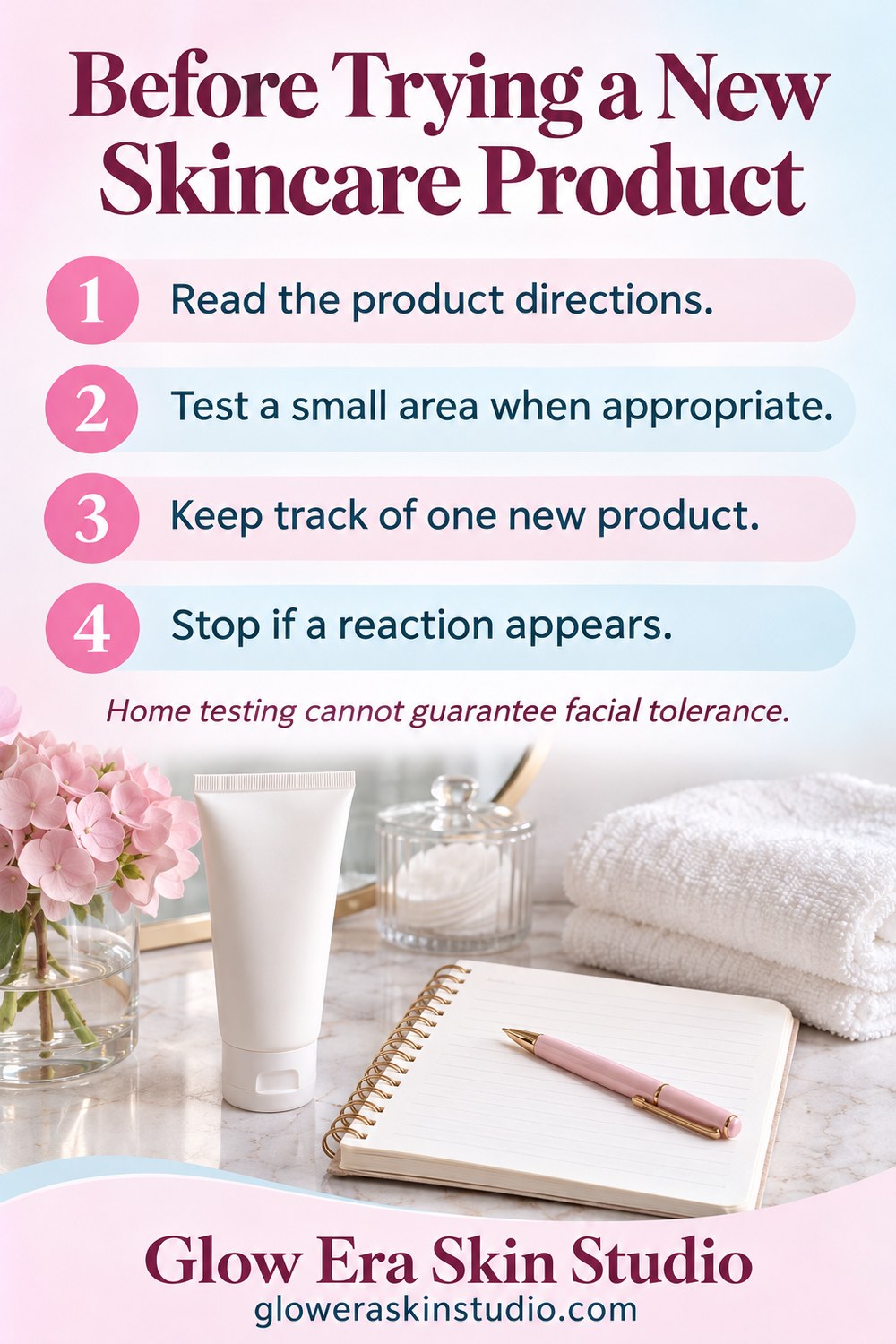
Before using a new skincare product across your face, test a small area first and follow the product’s directions. The American Academy of Dermatology recommends a home test on a small spot twice daily for seven to 10 days, with specific instructions for products that rinse off.
A small area test can help you notice a reaction before a product becomes part of your full routine, but it cannot guarantee that your face will tolerate it.
I’m Jenn, I’m 40, and I’m studying to become an aesthetician. At Glow Era Skin Studio, I share practical skincare education alongside the products and routines I use myself.
This guide explains the difference between trying a cosmetic carefully at home and having a dermatologist investigate an allergy. It also gives you a simple way to keep track of what you tried without turning your bathroom counter into a testing station.
Read the whole label before opening the product
Start by identifying what the product actually is. A plain moisturizer, a rinse off cleanser, an exfoliating treatment, and a prescription cream do not all belong in the same testing routine.
Read the application directions, warnings, intended areas, and storage instructions. Keep the outer box if important directions are printed there instead of on the bottle.
The home testing guidance below is general advice for suitable skincare products. Do not use it to override a product warning, increase the labeled frequency of an active treatment, or improvise instructions for a prescription.
If the label and a general testing guide seem to conflict, ask the manufacturer, pharmacist, or your dermatologist before proceeding. You do not need to resolve that uncertainty by experimenting on your face.
Know what an at home test can tell you
A home test is an observation step, rather than a diagnosis. You are looking for changes where you applied the product and keeping enough information to describe what happened.
DermNet explains that repeated open application testing can help investigate delayed contact reactions to personal care products. It also describes limitations, including different responses between a test area and thinner facial skin.
Passing a test on your arm does not prove that a product will suit your eyelids, prevent breakouts, or work well with every other product you own.
A home test also does not identify which ingredient caused a reaction. If your goal is to find the cause of repeated rashes, professional evaluation is more useful than collecting guesses about individual ingredients.
Follow a clear method for a suitable cosmetic
The AAD’s general method uses a spot about the size of a quarter on the underside of the arm or inside the elbow. It recommends the normal amount and thickness, applied twice daily for seven to 10 days.
A product intended to stay on the skin remains there as usual. For a cleanser or another rinse off product, the AAD advises leaving it for five minutes or for the time specified in its instructions before removal.
Follow the actual instructions for your product, especially when they specify a shorter contact time or a lower frequency. Do not treat this general method as permission to leave a rinse off product on overnight.
The complete procedure is available in the AAD guide to testing skincare products. Read it alongside the packaging before choosing your next step.

Make the test easy to keep track of
Write down the product’s full name and the date you started. A note that says “new cream” may be difficult to interpret if you have several similar jars.
Record where you applied it and whether you followed a rinse off or leave on method. Keep the note factual, with observations such as “itchy patch at the application spot” instead of deciding immediately that an ingredient is an allergen.
A private photograph can help you describe a visible change to your clinician. Use consistent lighting when possible and avoid treating changes in camera exposure as changes in your skin.
You do not need a complicated spreadsheet. A short entry in your existing notebook or phone notes can be enough to help you remember the sequence accurately.
Resist starting several new products together
Opening a cleanser, serum, moisturizer, and mask on the same evening creates several new variables. If your skin becomes uncomfortable, reconstructing what changed is much harder.
The AAD’s advice on getting results from antiaging products recommends starting with one product rather than several at once. That is a practical principle to use when organizing a routine change.
Keep unopened purchases in a separate place while you decide what to introduce first. This is an organizational suggestion, not a medically required waiting period between every kind of cosmetic.
You can make a simple note that the other products are waiting. Buying several items does not mean you need to begin using all of them before you can decide whether the first one belongs in your routine.
Do not let reassuring packaging replace checking
Terms such as “gentle,” “hypoallergenic,” and “for sensitive skin” can make a product feel like an automatic safe choice. They are still not a personal guarantee.
The FDA says there is no federal standard or definition governing the term “hypoallergenic” for cosmetics. A reassuring description does not remove the need to consider your own known allergies and the product’s ingredients.
Read the ingredient panel rather than relying only on the front label. If you know you react to an ingredient, a home test is not a reason to deliberately try a product containing it.
If the list leaves you unsure, contact the manufacturer or discuss it with your clinician. The FDA’s information on cosmetic allergens explains why ingredient information matters.
Stop when a reaction appears
Do not keep applying a cosmetic to a spot that has become red, itchy, swollen, or otherwise uncomfortable just to complete the calendar. The AAD advises gently removing a product that causes a reaction and not using it again.
A strong reaction or symptoms that do not settle deserve medical advice. Seek emergency help for trouble breathing, faintness, or swelling affecting the mouth or throat.
Avoid covering the reaction with several new treatments while also trying to work out what happened. Keep the product, packaging, and your notes available to share with the professional advising you.
If a prescription product is involved, contact the prescriber for instructions. Do not use a general cosmetic testing article to make changes to a prescribed treatment plan.
Understand when a dermatologist’s patch test is different
Professional patch testing is used to investigate allergic contact dermatitis. A clinician chooses test substances, manages their application, and interprets the readings in the context of your symptoms.
That is different from applying one finished moisturizer to a small area at home. Calling both processes a “patch test” can make the home version sound more conclusive than it is.
DermNet’s explanation of medical patch testing describes its role in investigating contact allergy. It is not a general test for every reason a face might sting or develop bumps.
If different cosmetics repeatedly cause problems, ask for help instead of assuming the next home test will solve the pattern. Your observations are useful information to bring to that conversation.
Decide what happens after the test
If you complete the appropriate test without a reaction, move forward using the product’s own directions. Keep its place in the routine clear rather than adding extra applications because the small area seemed comfortable.
Save the start date and any notes so you can refer back to them. If discomfort appears later, the earlier test is not a reason to ignore it.
You can also decide not to use the product yet. A purchase does not create an obligation to find room for it, particularly when your existing routine already feels manageable.
Testing is one part of introducing a product thoughtfully, not a promise that you need the product or will get a particular result.
For help making the rest of your routine easier to understand, explore The Skin Reset: 35+ Edition. It is an educational course, separate from individual medical advice or allergy testing.
Sources and further reading
AAD: How to test skincare products; AAD: Introducing antiaging products; DermNet: Open application testing; FDA: Hypoallergenic cosmetics.
This article provides general skincare education. It does not diagnose a reaction or replace advice from your dermatologist, pharmacist, or prescriber.
Leave a Reply