
Breakouts after 35 can leave you wondering why your skin seems to want acne care and extra moisture at the same time. Before you buy another bottle, let’s look at what may be contributing and how to choose a clearer next step.
Want help making sense of your routine? Explore The Skin Reset: 35+ Edition, my self-paced skincare course for adults navigating breakouts and changing skin.
In this post
- Why breakouts can continue after 35
- Hormones are one possibility, not the whole answer
- Dry patches and breakouts can coexist
- Check what is already touching your skin
- Build a routine you can actually follow
- Give treatment time, and know when to get help
- You do not need another guessing game
Why breakouts can continue after 35
Still buying acne products when you thought you would be shopping for fine lines? Having both concerns at once can feel frustrating. You are not behind, and you have not failed at skincare because your face still breaks out. Adult acne can persist long after your teenage years or appear after years of clearer skin.
There is no switch that flips on your thirty-fifth birthday. Age gives this conversation context, but it does not diagnose what is happening. The useful starting point is your current experience: what the spots look like, how your skin feels, what you use, and whether something has changed.
According to the American Academy of Dermatology’s overview of adult acne, several factors can contribute, including hormonal fluctuations, family history, and certain skincare or hair products. A routine that suited you at seventeen may need a different approach now.
Hormones are one possibility, not the whole answer
Breakouts can coincide with menstrual cycles, pregnancy, changes in birth control, or the menopause transition. That does not mean every chin spot is proof of a hormone problem. Where a breakout appears is a detail to record, not a reliable way to diagnose its cause yourself.
If you notice a repeating pattern, bring it to a healthcare professional. Mention other new symptoms and medications rather than trying to interpret your skin in isolation. Do not stop a prescribed medicine because you suspect a connection; ask the prescriber what to do.
Stress can also worsen existing acne, as the AAD’s explanation of acne causes describes. That is not a reason to blame yourself for being stressed. A calmer evening may feel helpful, but relaxation alone is not a substitute for appropriate acne care.
Dry patches and breakouts can coexist
An oily forehead does not cancel out uncomfortable cheeks. When your skin feels dry and you still have spots, reaching for something stronger can seem logical. But removing every trace of oil is not the same goal as managing acne, and a tight feeling after cleansing is not a useful measure of success.
The AAD’s guidance on skin during menopause notes that dryness and acne can occur together and advises avoiding acne products that dry the skin. Your needs may change, but that does not automatically mean buying an entirely new lineup.
Describe the two concerns separately. For example: “My cheeks feel tight after washing, and I have tender bumps around my chin.” That gives you something more useful to discuss than “Everything is wrong with my skin.” You can pay attention to comfort while getting help with recurring breakouts.
Check what is already touching your skin
Before ordering another treatment, take a quick look at your current products. Include makeup, sunscreen, conditioner, and styling products that reach your hairline. A product does not have to be applied as skincare to become part of the picture.
For acne-prone skin, non-comedogenic or “won’t clog pores” labeling can help narrow your choices. It cannot promise that every product will suit you. Also consider timing: did you start using something shortly before the change, or are you assuming your newest purchase must be responsible?
Keep your notes simple. Write the product name, when you started it, and what you noticed. Avoid changing five things at once if you can help it. If you already follow prescribed care, check with your clinician before changing that part of your routine.
Need a place to organize what you are noticing? The Skin Reset: 35+ Edition includes checklists, a skin observation journal, and routine planners to help you work through the overwhelm at your own pace.
Build a routine you can actually follow
Start by making your existing steps understandable. Which product cleanses? Which moisturizes? Which provides sun protection? Which is an acne treatment, and what do its directions say? An optional toner or mask should have a reason to be there beyond being part of a matching set.
Try writing your morning and nighttime steps in order. If the list is difficult to follow on a normal workday, consider which extras you could skip. The aim is a routine you understand well enough to repeat, including when you are tired.
My morning and night routine post shows how I organize my own products. It is an example, not a shopping prescription. You can borrow the idea of putting steps in order without buying everything I use.
If cleansing is the confusing part, read Double Cleansing 101. Whether you need an extra cleansing step depends on what you wore and how effectively your usual wash removes it, rather than how many steps someone else does.
Give treatment time, and know when to get help
Try not to judge an acne treatment by the next morning. The AAD’s guidance on habits that can worsen acne explains that some improvement can take six to eight weeks. Switching products every few days makes it harder to judge what helps and can add irritation.
Follow the directions for your specific treatment. Do not assume that using it more often will speed up the process. If a product causes a rash or significant irritation, stop using it and get advice; painful skin is not a requirement for making progress.
Deep, painful spots or acne that leaves scars deserve professional care. The AAD’s adult acne treatment guide recommends seeing a dermatologist for these concerns. Getting help is also reasonable when an appropriate over-the-counter approach is not working.
Bring your product list and any useful notes to the appointment. Ask what each treatment is for, when to expect a review, and what to do if irritation develops. You deserve instructions you can understand, rather than another collection of bottles you are unsure how to use.
Your next step does not have to be another product
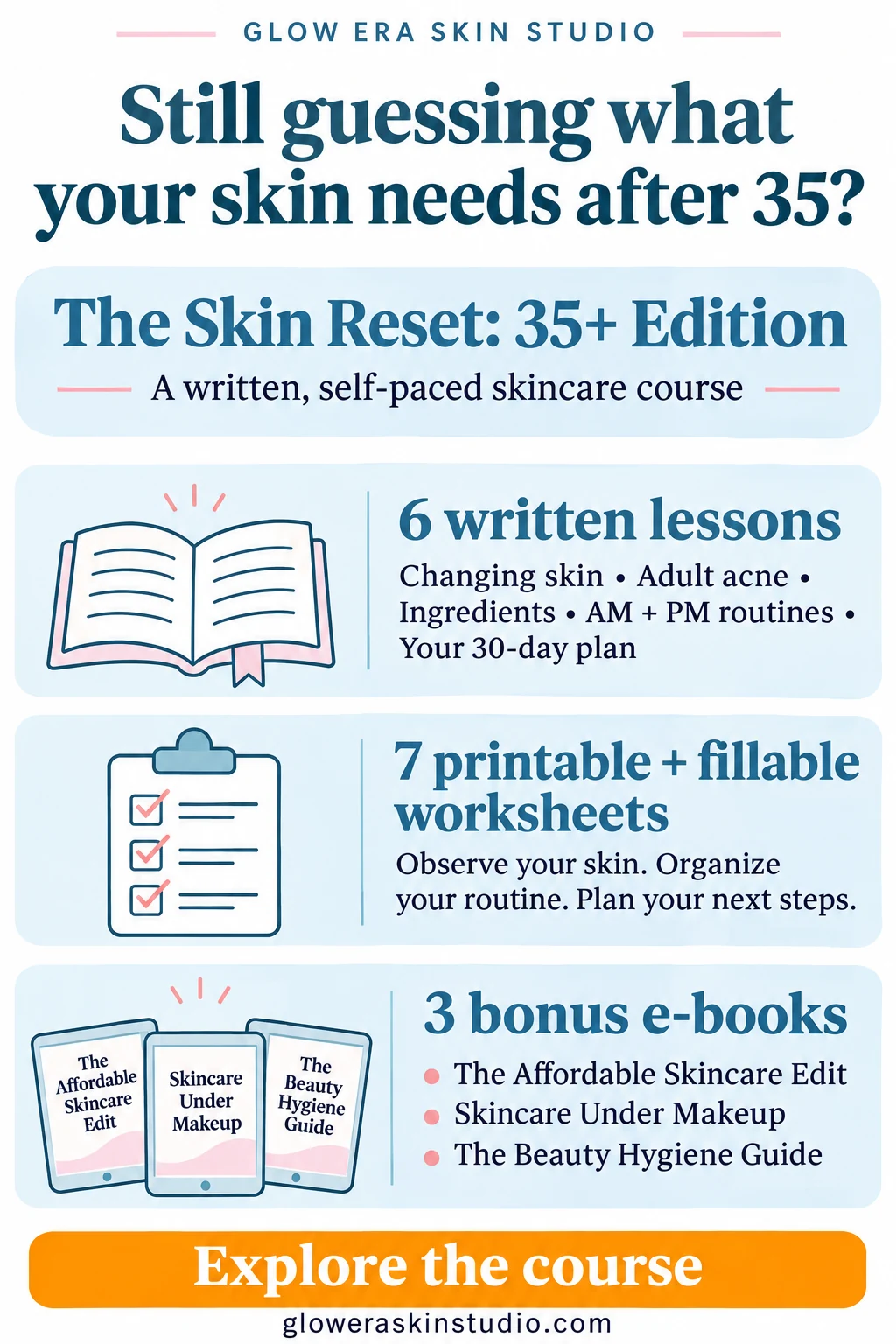
Still breaking out after 35 and tired of guessing what your skin needs? Turn the overwhelm into a routine you understand.
The Skin Reset: 35+ Edition gives you a practical place to start:
- 6 written, self-paced lessons on changing skin, adult acne, ingredients, and morning and nighttime routines.
- 7 fillable, printable worksheets to organize your observations, plan your routine, and map out your next 30 days.
- 3 bonus e-books: The Affordable Skincare Edit, Skincare Under Makeup, and The Beauty Hygiene Guide.
You do not need to figure out every bottle on your own. Take a look inside and see how the course can help you get organized.
This article and course provide skincare education, not a diagnosis or individualized treatment. Persistent, painful, or changing symptoms should be discussed with a qualified healthcare professional.
Leave a Reply